Wedding Vendor Comparison Worksheet: Compare Complete Quotes
Compare three wedding vendor quotes by scope, required extras, mandatory fees and confirmed tax. Edit the worksheet and download your comparison as CSV.
Sources and methods reviewed October 3, 2026. Tools use your inputs; survey figures retain their original observation years.
A proposal is only comparable when it covers the same event and work. This wedding vendor comparison worksheet adds missing required items, mandatory fees and quoted tax to each base price, then subtracts a confirmed discount. Keep unanswered questions in the notes.
The sample proposals are hypothetical. They demonstrate the method; they are not prices collected from a venue or supplier. Replace them with your quotes and export the CSV to retain your work.
Compare three wedding vendor quotes
Illustrative proposals. Compare the same event, coverage and inclusions. A missing price means unknown, not free. Entries stay in this page.
Copy or view CSV
Your entries stay in this page. A zero may mean an item is included, unnecessary or not yet priced. Explain which in the notes. Do not describe an incomplete total as a supplier's final price.
Embed this graphic with its source note
Our original graphic is available under CC BY 4.0. Credit All Wedding and retain the underlying source and scope. This permission covers our graphic, not a publisher's complete report.
Establish the same scope first
Write one event brief before comparing prices: date, location, attendance, coverage hours, deliverables, setup and cleanup responsibilities. Send that brief to each candidate.
Category-specific scope makes the comparison more useful:
- Photography: named photographer, additional staff, locations, hours, editing, delivery and albums.
- Venue: exact spaces, access times, furniture, weather backup, staffing and required suppliers.
- Catering: menu, service format, billed headcount, staff, equipment, bar and dessert service.
- Cake: baker-confirmed portions, design, delivery, setup, stand rental and serving responsibility.
- Planning: decisions and tasks owned by the planner, attendance at meetings, event-day coverage and handover.
A supplier can be a better fit even if their complete quote is higher. The worksheet organizes costs; it does not measure creative quality, suitability or reliability.
Add missing required items
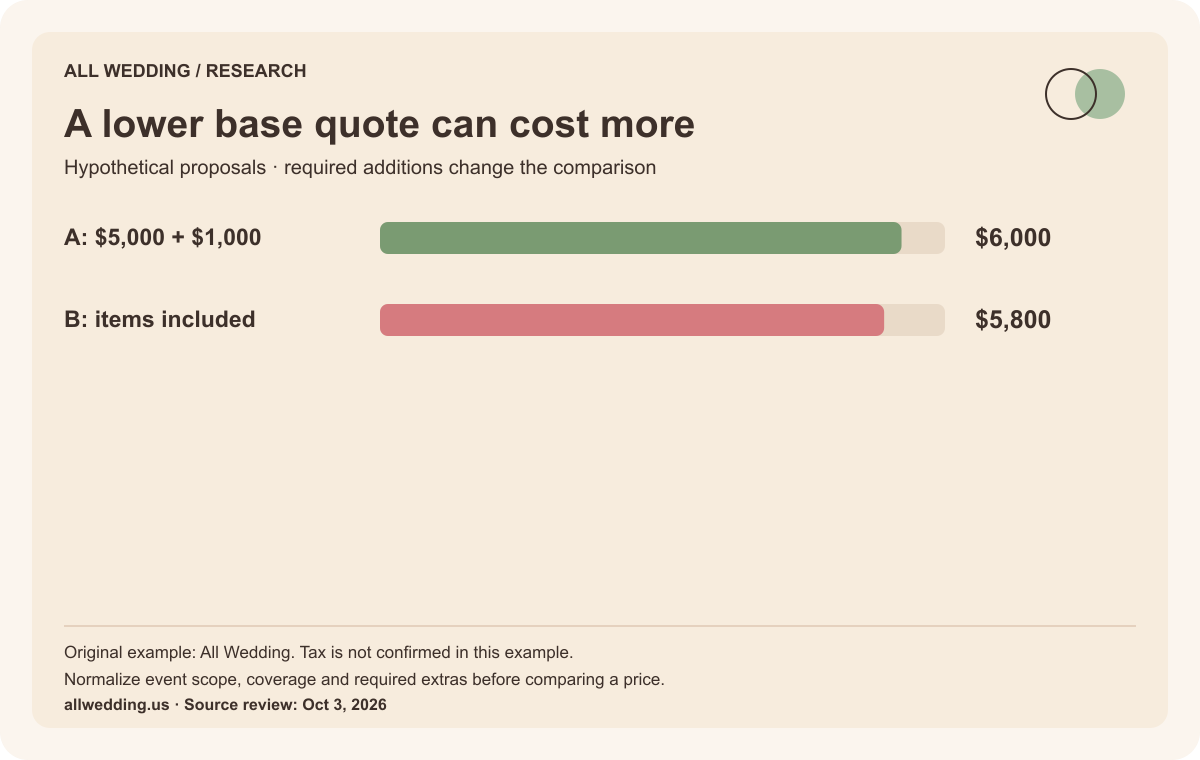
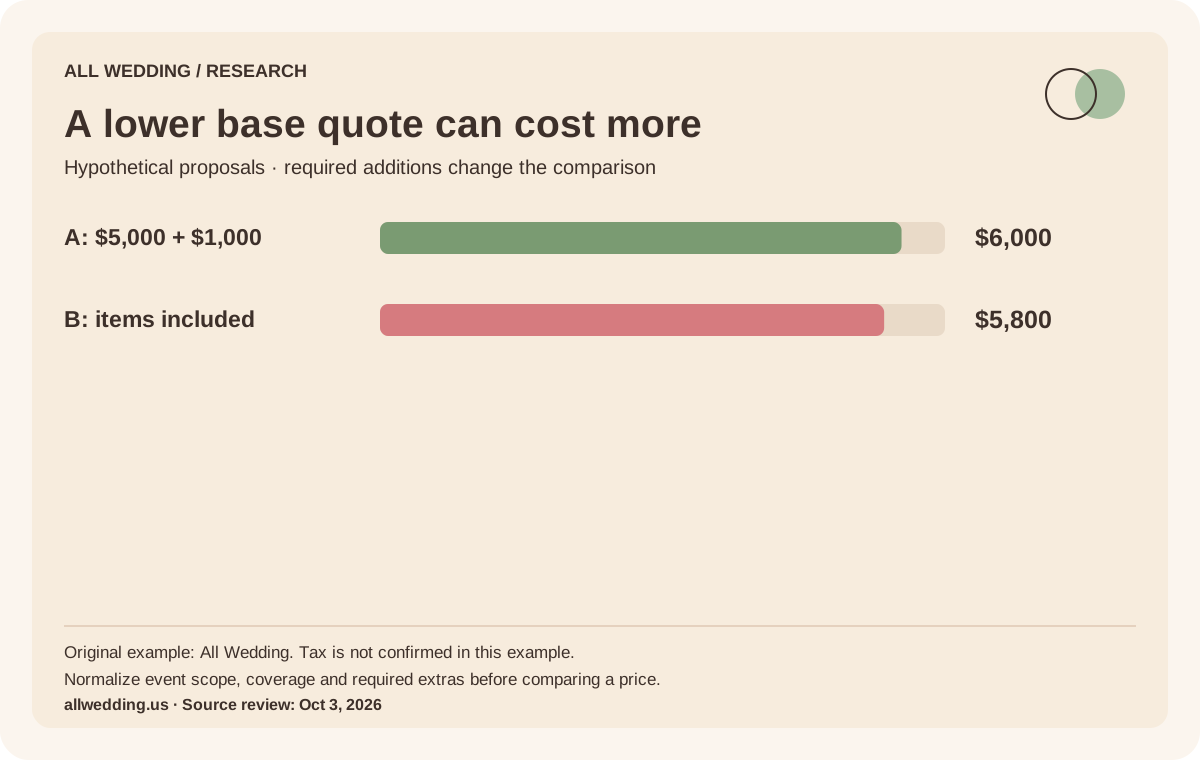
In the example, Proposal A starts at $5,000. It needs $700 of missing scope plus $300 of mandatory fees, producing $6,000 before unconfirmed tax. Proposal B includes the required scope for $5,800 before unconfirmed tax.
The example's $200 difference follows from those invented inputs. The point is to compare a complete scope, not to assume any supplier hides charges.
Only add an item when your event needs it and it is absent from the base quote. Optional upgrades belong in a separate scenario. Keep a line-by-line note so you can explain the extras rather than entering an unexplained allowance.
Avoid double counting and guessed discounts
Included chairs should not also appear as missing rentals. A catering service charge already in the base quote should not be added again. Ask a supplier to clarify ambiguous inclusions instead of deciding from a package name.
Enter tax as the quoted dollar amount. This tool does not infer a jurisdiction's tax treatment. Record unknown tax prominently until you have a written answer.
A confirmed discount is a reduction the supplier has offered for this proposal. It is not a hoped-for negotiation. A lower deposit also is not a discount: compare the full balance and record the payment schedule separately.
Keep evidence beside each proposal
Use the notes for the named team, exclusions, availability, proposal expiry and questions still open. A portfolio link or sample gallery is evidence for a creative service; an itemized scope is evidence for what you are buying. Neither replaces the other.
Record the actual cancellation and rescheduling wording from the agreement and seek clarification where needed. This cost worksheet does not interpret contract enforceability or decide which terms you should accept.
If packages differ substantially, request a revised proposal matching your brief. Comparing two incompatible packages more precisely does not make them equivalent.
Use the right companion worksheet
The venue tour checklist, photography shot list, catering menu worksheet and floral proposal worksheet help define required work before you put prices into the comparison.
Use vendor inquiry email templates to ask consistent questions. Find candidates through city directories and the vendor categories.
Download and update the comparison
Export after entering your providers, amounts and notes. The file includes the normalized cost calculation and a link to this method. Keep the original proposals with it and date revisions when scope changes.
Move the confirmed totals into the wedding budget calculator. Industry vendor statistics can explain common categories, but the category averages cannot price your event.
This worksheet and its illustrative graphic are original All Wedding tools. No vendor quotations were used to create the example.