Wedding Budget Calculator: Guests, Quotes, Fees and Reserve
Calculate a wedding budget from your own fixed costs, per-guest quotes, known fees and tax. Export a transparent CSV with every assumption.
Sources and methods reviewed October 3, 2026. Tools use your inputs; survey figures retain their original observation years.
A useful wedding budget starts with your event and your quotes. This calculator separates fixed costs from costs that change with attendance, then adds the service charge, tax and planning reserve you enter. Its starting numbers are an example, not a national average or a prediction.
Change the inputs to match your proposals. A zero for an unpriced item means the budget is incomplete. Your entries stay in this page; download the CSV to keep a copy before leaving.
Calculate your wedding budget
Example inputs only. Replace them with your quotes. Entries stay in this page and are not submitted to All Wedding.
Modeled budget including reserve
- Food and drinks
- $12,000
- Other guest-dependent costs
- $1,800
- Fixed costs
- $12,000
- Service on food/drinks
- $2,400
- Tax on entered taxable amount
- $0
- Planning reserve
- $2,820
Copy or view CSV
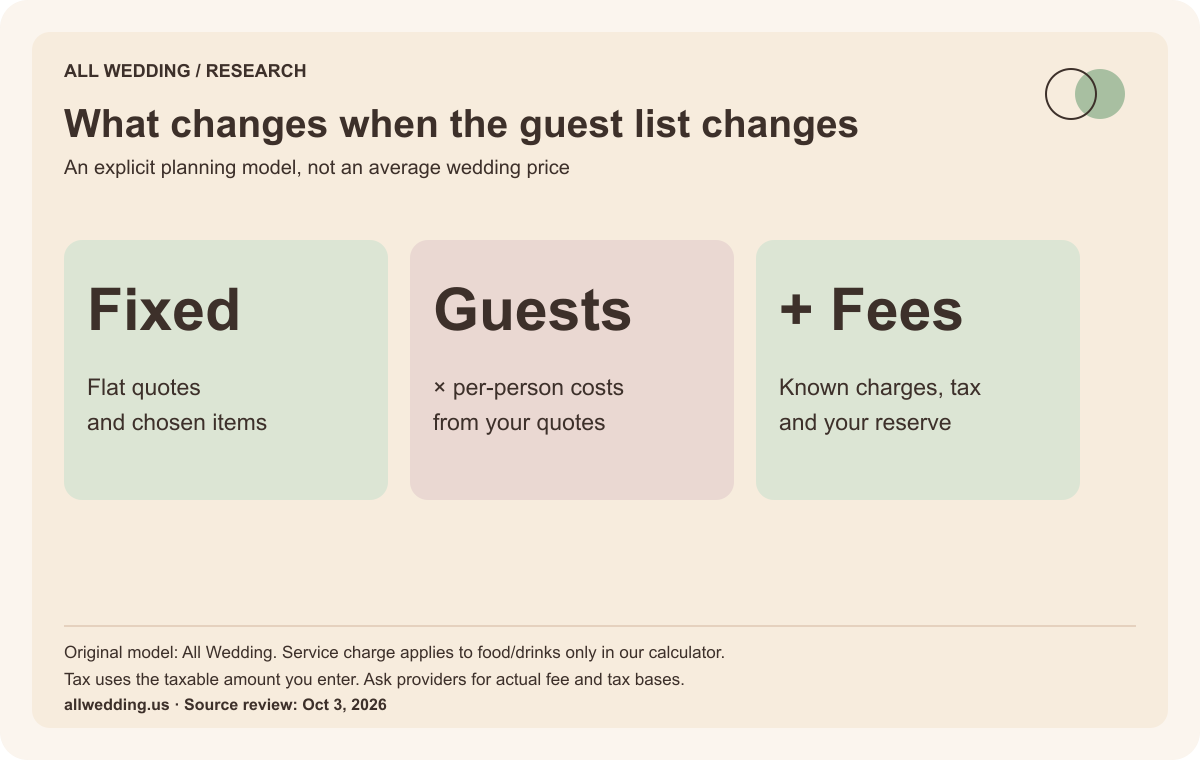
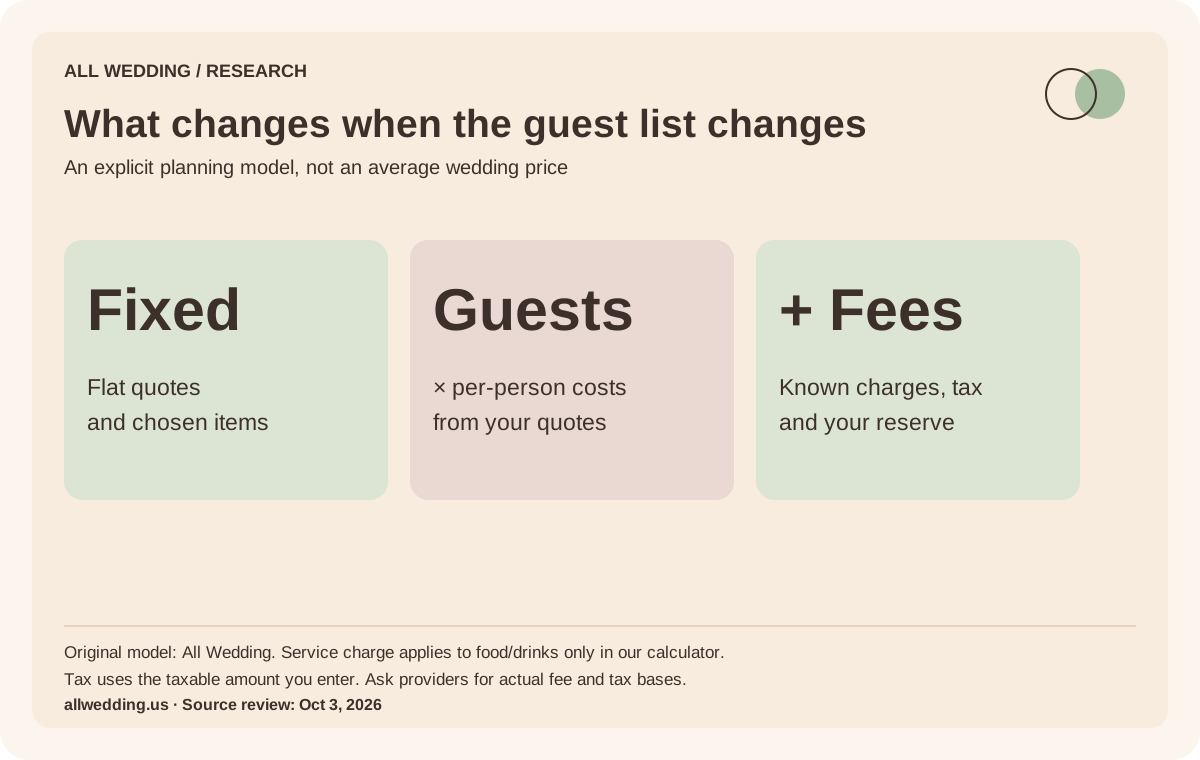
The model is: fixed costs + guest count × per-guest costs + entered service charge + entered tax + chosen reserve. The service-charge percentage applies only to the food/drink subtotal in this tool. Tax applies only to the taxable dollar amount you enter. Check each proposal before choosing those inputs.
Embed this graphic with its source note
Our original graphic is available under CC BY 4.0. Credit All Wedding and retain the underlying source and scope. This permission covers our graphic, not a publisher's complete report.
Separate fixed costs from guest-dependent costs
A photographer's agreed package, venue rental or ceremony musician may be fixed within the quoted scope. Food, drinks, invitations and some rentals can vary with quantities. Other expenses change in steps: another table, another shuttle trip, an extra server or a larger room.
Use the fixed-cost box for the total of your confirmed fixed lines. Use food/drinks per guest for the actual quoted rate, and other per-guest costs for the remaining quantity-dependent lines. Keep an itemized working budget alongside the calculator so you can see what went into each total.
Minimum spends and minimum billed headcounts complicate the model. Reducing attendance below a catering minimum may not reduce the bill. If a proposal has tiers, calculate each scenario from the quote rather than extending one per-person rate across every guest count.
Model a guest-list change without promising savings
In the starting example, food/drinks are $100 per guest and other guest-dependent costs are $15. Ten fewer guests therefore reduce those two modeled lines by $1,150 before service charges and reserve. That is arithmetic on illustrative inputs.
It is not a measured saving for ten guests at any particular venue. A supplier's minimum, quantities already ordered or a staffing threshold could change the result. Recalculate using the proposal's actual rules before treating a scenario as available.
For dessert quantities, use the cake serving calculator. For meal service, the catering menu worksheet helps distinguish food, staffing, rentals and bar service.
Enter charges from the proposal
Ask which lines a service charge covers, whether it is already included, and which other fees appear. Do not automatically add a percentage to the whole budget. A label such as “service” does not by itself tell you how it relates to staffing or gratuities; request an explanation.
For tax, enter the confirmed taxable amount and rate for your proposal. This tool does not determine tax rules. Leaving both inputs at zero keeps tax out of the estimate; it does not establish that no tax applies.
The reserve is a planning choice. It adds a buffer to the modeled subtotal but does not pay for items you forgot to include. Review transport, alterations, delivery, extra coverage, setup, cleanup and rental returns as actual scope questions.
Compare proposals before combining them
The vendor comparison worksheet normalizes three proposals by adding missing required items and known charges. It can expose a cheaper headline quote with a higher complete cost.
Avoid counting the same item twice. If a venue package includes chairs, do not also add a separate chair rental unless your floor plan requires more or different chairs. If catering already includes dessert service, confirm the cake-cutting scope before adding another fee.
Use our vendor inquiry templates to request an itemized proposal, deadlines and exclusions from your shortlist. Then compare venues, photographers, planners, bakeries and catering for current availability.
Save assumptions with the number
The CSV includes your inputs and the calculated lines. Keep the supplier proposal, date and unresolved questions with that file. An estimate with unknown tax, missing transport or tentative attendance should remain labeled as an estimate.
For source-linked industry context, see wedding cost statistics. The national mean and median describe a survey cohort; neither is a required budget. Your affordable total and your event's written scope determine the plan.
Calculator method
This is an original All Wedding planning model. It rounds money to cents, uses whole guests and does not allow negative charges. It does not retrieve prices, save your inputs, book suppliers or submit an inquiry. The graphic documents the same formula used by the calculator.